Why Is Life in the Capital More Expensive?
The story of a city where creating more opportunities can make everyday life harder.
Let's try a thought experiment.
Imagine waking up one morning to find that all of Tehran's buildings, with everything inside them, have appeared exactly as they were on an empty plain, hundreds of kilometres away.
The same towers, apartments, elegant shops and cafés. Even the streets and their asphalt are unchanged.
Only one thing is missing: this place is no longer the capital. The concentration of companies, universities, specialist hospitals, customers, professional connections and opportunities that has developed in Tehran is gone.
Now the question:
Are those apartments still worth as much as before?
Probably not.
This means that an important part of what we pay for a home in the capital does not buy bricks, cement or windows. It buys something we cannot see inside the home at all: the possibilities that exist outside its door.
That is where I want to begin with an idea I find more interesting than many familiar explanations of why cities are expensive:
The capital is a place where people compete to move closer to their possible futures, as well as a place where they buy goods and services.
And that competition has a price.
First: in the capital, we pay for things that have not happened yet
There is a book called Order without Design: How Markets Shape Cities by Alain Bertaud, an urban planner and researcher who has spent years studying urban structure and the relationships between labour markets, transport and land prices.
In this book, published by MIT Press in 2018, Bertaud sees the city primarily as a large labour market whose performance depends on people's ability to reach one another.
To understand his point, imagine two people.
Sara lives in a small city. In her profession, only four companies might employ her.
Her friend Nazanin lives in the capital. There may be dozens of companies that need her skills.
Today, both earn exactly the same salary.
But if they lose their jobs tomorrow, their situations will differ. Nazanin will probably have more choices. She might even find a better job without moving home.
So Nazanin's life in the capital depends on more than today's job. It also offers the possibility of tomorrow's job, future professional connections, potential training and paths she has yet to try.
In economics, part of this appeal can be described through option value: the value people gain from having more choices, even before they use them.
This helps explain why someone might knowingly choose a smaller, more expensive home in a large city.
They are buying a home and access to a collection of opportunities.
But there is a subtle point here: if thousands of people reach the same conclusion and move closer to those opportunities, competition for housing rises.
Something intended to improve life can itself make life more expensive.
This is the first paradox of the big city.
Second: more than a century ago, someone illustrated this paradox with three magnets
One particularly rewarding book on this subject is Garden Cities of To-Morrow, written by Ebenezer Howard in 1902.
Rather than talking only about statistics and prices, Howard imagined town and country as two magnets, each drawing people towards its attractions. He then proposed a third magnet: a settlement combining the advantages of urban life and nature.
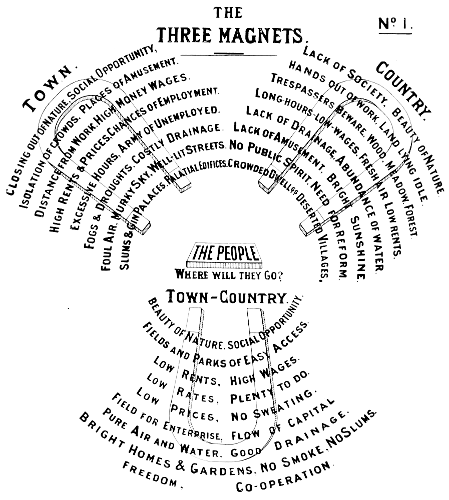
What is striking is that Howard was writing about the high cost of urban life more than a century ago.
The Town magnet, it will be seen, offers, as compared with the Country magnet, the advantages of high wages, opportunities for employment, tempting prospects of advancement, but these are largely counterbalanced by high rents and prices. Its social opportunities and its places of amusement are very alluring, but excessive hours of toil, distance from work, and the “isolation of crowds” tend greatly to reduce the value of these good things. The well-lit streets are a great attraction, especially in winter, but the sunlight is being more and more shut out, while the air is so vitiated that the fine public buildings, like the sparrows, rapidly become covered with soot, and the very statues are in despair. Palatial edifices and fearful slums are the strange, complementary features of modern cities.
What I particularly like in this paragraph is the phrase ‘isolation of crowds’.
Howard sees more than an economic problem. He asks: what use are a city's thousands of opportunities for recreation and social life if people have to work so much, and spend so long travelling, that they have no time to enjoy them?
A city can simultaneously be rich in amenities and poor in the time and peace available to its residents.
This brings us to prices that never appear on a price tag.
Third: perhaps the strangest part of the capital's high cost is that we pay even for things that are ‘free’
There is a book with the almost humorous title The High Cost of Free Parking, written by Donald Shoup, a professor of urban planning at UCLA.
In this 2005 book, Shoup examines something most people never think about when shopping: the cost of parking cars.
A short sentence from the book's first chapter:
The cost of parking is hidden in higher prices for everything else.
Imagine a restaurant that needs enough space for twenty tables. It must also dedicate another part of its land or building to parking.
Parking may be ‘free’ to the customer, but building and maintaining it was not free. If the restaurant recovers that cost through food prices, even someone without a car may pay part of the cost of other people's parking.
This is specifically part of Shoup's discussion of certain American cities; we should not assume Tehran has the same parking rules or the same ways of passing on costs.
Now take this a step further.
Land in a busy part of the capital is scarce and in demand. Dedicating it to one activity means giving up other possible activities. Economists call this opportunity cost.
And the idea extends beyond parking.
Imagine two coffee shops using the same beans, equipment and recipe. One is on a quiet street; the other is near offices, where people are rushing to meetings.
At the second shop, a customer may pay for more than the coffee's quality. They may also be willing to pay to avoid spending twenty minutes searching for coffee.
If enough customers share that preference, the location becomes more profitable for the café. The property's owner may then ask for higher rent.
Some of the value customers place on saving time may eventually become income for the property's owner.
And this is a rather strange point:
Sometimes the money we pay for our own convenience ultimately goes to the person who owns the place that makes it convenient.
This does not mean that rent explains every difference in prices. Competition, quality, wages and profit margins also matter.
Fourth: the capital can create wealth without making all its residents wealthier
In The New Geography of Jobs, economist Enrico Moretti explores the relationship between employment, innovation and geography.
One of his ideas is that when well-paid, specialised jobs cluster in a city, demand also rises for other jobs: restaurants, drivers, nurses, cleaners, consultants and dozens of other services.
In his research on American labour markets, Moretti has estimated substantial local employment multipliers for certain innovative jobs.
Now imagine a scene.
A large company opens a new office on a street. Hundreds of new employees enter the neighbourhood. The café opposite becomes busier. Its owner might hire another employee.
Everything seems to be going well.
But the café's landlord also notices that there is now more demand for that location. When the lease is renewed, the rent may rise.
The café sells more but pays more too. Its employee may earn higher wages but also need to pay more rent to live in the same neighbourhood.
Meanwhile, depending on market conditions, the property's owner may benefit from the location's increased value without taking part in making coffee.
We are dealing with three kinds of income: earnings from work, profits from economic activity, and income from owning a scarce asset.
These do not necessarily rise equally as the city grows.
So new towers, successful companies and busy restaurants do not by themselves prove that life has improved for every resident.
The city may become wealthier without all its people feeling proportionately wealthier.
Fifth: a metro station is built — but who becomes wealthier?
Imagine two neighbours living in the same building.
One owns their home. The other rents.
One day, a new metro station is announced near their building. A few years later, it opens.
Now both can get to work more easily. Both benefit from a public amenity.
But there is an important difference.
If improved access increases housing prices in the neighbourhood, the homeowner gains a more valuable asset. The tenant, meanwhile, may face higher rent when the lease is renewed.
One gains wealth from the city's improvement; the other may have to pay more to remain in it.
This is more than an unsupported thought experiment. Researchers have repeatedly studied how the value of access becomes reflected in land and housing prices. Findings differ: a meta-analysis published in 2022 shows that rail stations can be associated with decreases or increases in property value, depending on location and conditions.
This is where Capital City: Gentrification and the Real Estate State, written by Samuel Stein and published in 2019, becomes particularly relevant.
From the perspectives of political economy and geography, Stein argues that planning decisions, investment and changes in land use can alter property values, with the resulting gains distributed unevenly across social groups.
Putting these studies together suggests the following:
When a city improves, the question is how much value has been created and who can keep that value for themselves.
This is one reason the cost of city life cannot be explained simply by population size. Land ownership, housing supply, infrastructure and planning decisions matter too.
In a capital, the concentration of government offices and decision-making power can make this process more complicated. In their 1995 study Trade and Circuses, Alberto Ades and Edward Glaeser showed that political structures, alongside trade and economic factors, can influence population concentration in a country's principal city.
This pattern is not universal. A country's political capital is not necessarily its most expensive city or its main economic centre.
Sixth: perhaps the hardest part is that rising costs mean different things to different people
Here I want to discuss a real example rather than a hypothetical one.
Sociologist Matthew Desmond closely followed several low-income families in Milwaukee, in the United States. His work became the 2016 book Evicted: Poverty and Profit in the American City.
One of the book's real people is Arleen, a mother of two children.
In an interview published by the book's publisher, Desmond says that when he met Arleen, rent consumed 88 percent of her income.
She repeatedly had to leave her home. Her children lost familiar schools and communities, and her eviction record made finding the next home more difficult.
In the book, Desmond uses a short, unsettling expression:
the rent eats first.
This story concerns Milwaukee, rather than Tehran or a capital city, but it matters greatly for understanding the social effects of expensive housing.
Imagine two families living on the same street. The cost of living there rises for both.
One owns a home that is gaining value. The other spends most of its income on rent.
Statistics may describe both as ‘residents of an expensive neighbourhood’, although their economic experiences are worlds apart.
For the first, rising costs may mean becoming wealthier. For the second, they may mean giving up medical care, leisure or education, or even being forced to move.
This difference easily disappears in broad analyses of ‘average Tehran prices’.
Interestingly, more than a century ago, Charles Booth and his colleagues coloured London's streets according to the economic circumstances of their residents.
Their historic maps sometimes show prosperous and poor streets very close together. In one part of Spitalfields, even opposite sides of the same street were marked with colours denoting prosperity and poverty.
You can explore these original maps in the LSE's digital archive.
This historical image reminds us that a metropolis may be a single city geographically while containing several different worlds of lived experience.
Seventh: some expensive things build a future rather than display wealth
A less frequently discussed and particularly interesting book here is The Sum of Small Things: A Theory of the Aspirational Class, written by Elizabeth Currid-Halkett and published in 2017.
She examines a question in the sociology of consumption: affluent people do not always display their wealth through expensive cars, luxury watches or designer clothes. Their more consequential spending may go towards children's education, health, childcare and activities that help preserve or improve the family's social position.
A short sentence from the book's first chapter:
The distance across classes is not simply defined by the stuff people own.
Now connect this to urban life.
Imagine two identical homes. One is in a neighbourhood with easier access to a sought-after school, healthcare and a range of educational activities for children.
A family may pay more for the second home because of the opportunities it creates for their child, rather than because of the building itself.
Housing prices can therefore reflect competition between families over the next generation's opportunities, as well as the amenities available today.
This is where sociology, psychology and urban economics meet.
In capitals where educational and specialist services are more concentrated, this competition may explain some of the intense demand for particular neighbourhoods.
Eighth: there is another cost that never appears on the receipt — time
In Happy City: Transforming Our Lives Through Urban Design, written by Charles Montgomery in 2013, the city is an environment that affects behaviour, social relationships and satisfaction with life, as well as a collection of buildings. The author explores this through psychology, behavioural science and urban planning experiences.
Now consider a familiar choice.
You can live near work but pay high rent.
Or you can choose a cheaper home farther away and spend more time travelling every day.
In the first case, you pay money for access.
In the second, you give up some of your time to live more cheaply.
And that time matters. It is time you could spend with family, sleeping, exercising or learning something.
Remember Howard's paradox from the beginning: a city full of recreation and social opportunities whose residents may not have enough time to use them.
This is where we realise that ‘the cost of living’ and ‘the price of things’ are different concepts.
A home may be cheaper while living there imposes considerable time and psychological costs on someone who has to travel a long distance every day.
So why is the capital more expensive?
Now we can return to the opening question.
A capital generally brings several kinds of scarcity together: land close to employment opportunities, homes with good access to services and amenities, busy commercial space and locations valuable for economic and social relationships.
When more people compete for access to these things and the supply of land, housing and infrastructure does not respond adequately, prices come under pressure.
This pressure affects different goods differently. A manufactured product may be cheaper in the capital because of intense competition and extensive distribution networks. Housing, haircuts, restaurants and services closely tied to location and labour costs, by contrast, may cost more.
General inflation across the country is a separate factor that can operate alongside these spatial differences.
For me, the deepest conclusion of these books and studies is this:
The capital is a place where people compete for a share of limited opportunities, as well as a place with higher prices.
Some earn income as these opportunities grow. Others pay more to reach them. Still others may live in the same city without access to much of what it offers.
Perhaps the whole story can be put this way:
In a large city, some people become wealthier as the city moves closer to their property; others must spend more of their income and their lives to keep themselves close to the city.
That difference matters even more than the high prices themselves.