Why Does a Child Fight a Chair?
A passage from Stevenson’s Child’s Play: a story that needs a body, a chair and the things in a room to happen.
We grown people can tell ourselves a story, give and take strokes until the bucklers ring, ride far and fast, marry, fall, and die; all the while sitting quietly by the fire or lying prone in bed.
This is exactly what a child cannot do, or does not do, at least, when he can find anything else. He works all with lay figures and stage properties. When his story comes to the fighting, he must rise, get something by way of a sword and have a set-to with a piece of furniture, until he is out of breath.
When he comes to ride with the king’s pardon, he must bestride a chair, which he will so hurry and belabour and on which he will so furiously demean himself, that the messenger will arrive, if not bloody with spurring, at least fiery red with haste. If his romance involves an accident upon a cliff, he must clamber in person about the chest of drawers and fall bodily upon the carpet, before his imagination is satisfied.
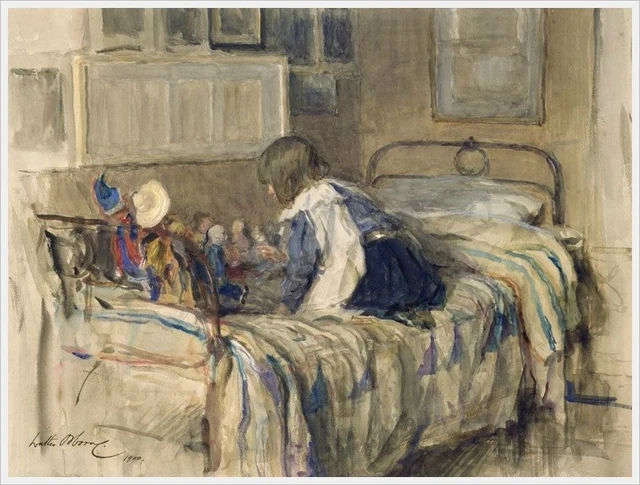
Lead soldiers, dolls, all toys, in short, are in the same category and answer the same end. Nothing can stagger a child’s faith; he accepts the clumsiest substitutes and can swallow the most staring incongruities.
The chair he has just been besieging as a castle, or valiantly cutting to the ground as a dragon, is taken away for the accommodation of a morning visitor, and he is nothing abashed; he can skirmish by the hour with a stationary coal-scuttle; in the midst of the enchanted pleasance, he can see, without sensible shock, the gardener soberly digging potatoes for the day’s dinner.
He can make abstraction of whatever does not fit into his fable; and he puts his eyes into his pocket, just as we hold our noses in an unsavoury lane.
And so it is, that although the ways of children cross with those of their elders in a hundred places daily, they never go in the same direction nor so much as lie in the same element. So may the telegraph wires intersect the line of the high-road, or so might a landscape painter and a bagman visit the same country, and yet move in different worlds.