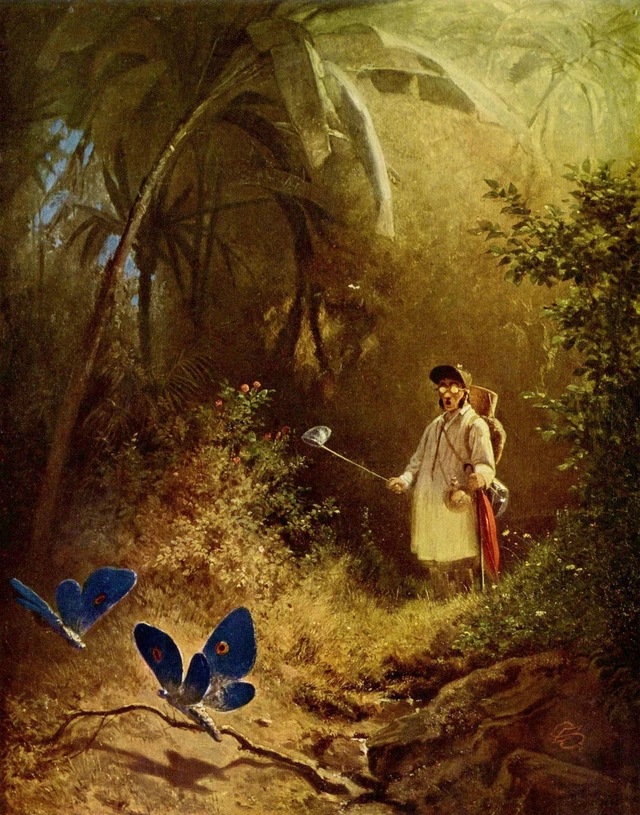
The Watchmaker Who Made a Butterfly
The butterfly’s unveiling in Hawthorne’s “The Artist of the Beautiful”: Owen shows his friends the result of years of work.
“I have succeeded,” replied the artist, with a momentary light of triumph in his eyes and a smile of sunshine, yet steeped in such depth of thought that it was almost sadness. “Yes, my friends, it is the truth. I have succeeded.”
“Indeed!” cried Annie, a look of maiden mirthfulness peeping out of her face again. “And is it lawful, now, to inquire what the secret is?”
“Surely; it is to disclose it that I have come,” answered Owen Warland. “You shall know, and see, and touch, and possess the secret! For, Annie,—if by that name I may still address the friend of my boyish years,—Annie, it is for your bridal gift that I have wrought this spiritualized mechanism, this harmony of motion, this mystery of beauty. It comes late, indeed; but it is as we go onward in life, when objects begin to lose their freshness of hue and our souls their delicacy of perception, that the spirit of beauty is most needed. If,—forgive me, Annie,—if you know how—to value this gift, it can never come too late.”
He produced, as he spoke, what seemed a jewel box. It was carved richly out of ebony by his own hand, and inlaid with a fanciful tracery of pearl, representing a boy in pursuit of a butterfly, which, elsewhere, had become a winged spirit, and was flying heavenward; while the boy, or youth, had found such efficacy in his strong desire that he ascended from earth to cloud, and from cloud to celestial atmosphere, to win the beautiful. This case of ebony the artist opened, and bade Annie place her fingers on its edge. She did so, but almost screamed as a butterfly fluttered forth, and, alighting on her finger’s tip, sat waving the ample magnificence of its purple and gold-speckled wings, as if in prelude to a flight. It is impossible to express by words the glory, the splendor, the delicate gorgeousness which were softened into the beauty of this object. Nature’s ideal butterfly was here realized in all its perfection; not in the pattern of such faded insects as flit among earthly flowers, but of those which hover across the meads of paradise for child-angels and the spirits of departed infants to disport themselves with. The rich down was visible upon its wings; the lustre of its eyes seemed instinct with spirit. The firelight glimmered around this wonder—the candles gleamed upon it; but it glistened apparently by its own radiance, and illuminated the finger and outstretched hand on which it rested with a white gleam like that of precious stones. In its perfect beauty, the consideration of size was entirely lost. Had its wings overreached the firmament, the mind could not have been more filled or satisfied.
“Beautiful! beautiful!” exclaimed Annie. “Is it alive? Is it alive?”
“Alive? To be sure it is,” answered her husband. “Do you suppose any mortal has skill enough to make a butterfly, or would put himself to the trouble of making one, when any child may catch a score of them in a summer’s afternoon? Alive? Certainly! But this pretty box is undoubtedly of our friend Owen’s manufacture; and really it does him credit.”
At this moment the butterfly waved its wings anew, with a motion so absolutely lifelike that Annie was startled, and even awestricken; for, in spite of her husband’s opinion, she could not satisfy herself whether it was indeed a living creature or a piece of wondrous mechanism.
“Is it alive?” she repeated, more earnestly than before.
“Judge for yourself,” said Owen Warland, who stood gazing in her face with fixed attention.
The butterfly now flung itself upon the air, fluttered round Annie’s head, and soared into a distant region of the parlor, still making itself perceptible to sight by the starry gleam in which the motion of its wings enveloped it. The infant on the floor followed its course with his sagacious little eyes. After flying about the room, it returned in a spiral curve and settled again on Annie’s finger.
“But is it alive?” exclaimed she again; and the finger on which the gorgeous mystery had alighted was so tremulous that the butterfly was forced to balance himself with his wings. “Tell me if it be alive, or whether you created it.”
“Wherefore ask who created it, so it be beautiful?” replied Owen Warland. “Alive? Yes, Annie; it may well be said to possess life, for it has absorbed my own being into itself; and in the secret of that butterfly, and in its beauty,—which is not merely outward, but deep as its whole system,—is represented the intellect, the imagination, the sensibility, the soul of an Artist of the Beautiful! Yes; I created it. But”—and here his countenance somewhat changed—“this butterfly is not now to me what it was when I beheld it afar off in the daydreams of my youth.”
“Be it what it may, it is a pretty plaything,” said the blacksmith, grinning with childlike delight. “I wonder whether it would condescend to alight on such a great clumsy finger as mine? Hold it hither, Annie.”
By the artist’s direction, Annie touched her finger’s tip to that of her husband; and, after a momentary delay, the butterfly fluttered from one to the other. It preluded a second flight by a similar, yet not precisely the same, waving of wings as in the first experiment; then, ascending from the blacksmith’s stalwart finger, it rose in a gradually enlarging curve to the ceiling, made one wide sweep around the room, and returned with an undulating movement to the point whence it had started.
“Well, that does beat all nature!” cried Robert Danforth, bestowing the heartiest praise that he could find expression for; and, indeed, had he paused there, a man of finer words and nicer perception could not easily have said more. “That goes beyond me, I confess. But what then? There is more real use in one downright blow of my sledge hammer than in the whole five years’ labor that our friend Owen has wasted on this butterfly.”