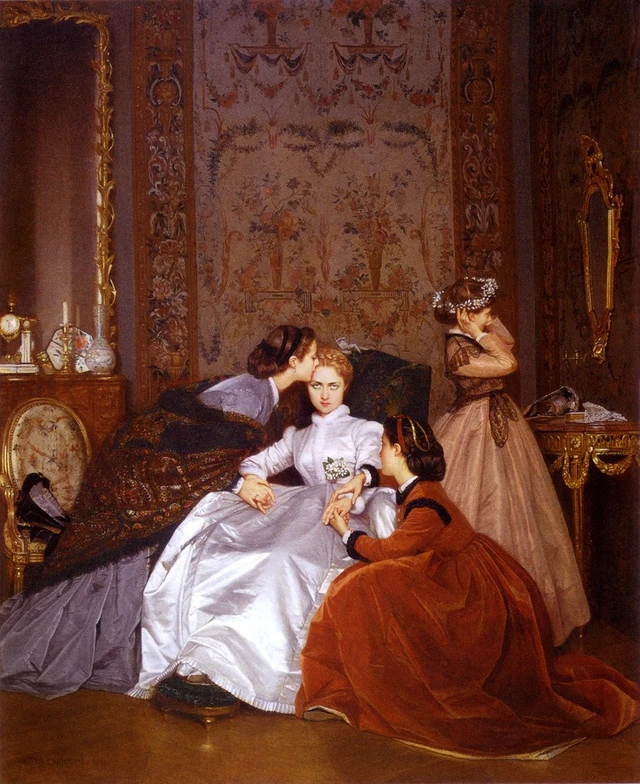
How Long Must I Stand by My Decision?
A passage from On Liberty on leaving a commitment, and what we owe to people who have relied on it.
The principle, however, which demands uncontrolled freedom of action in all that concerns only the agents themselves, requires that those who have become bound to one another, in things which concern no third party, should be able to release one another from the engagement: and even without such voluntary release, there are perhaps no contracts or engagements, except those that relate to money or money's worth, of which one can venture to say that there ought to be no liberty whatever of retractation.
Baron Wilhelm von Humboldt, in the excellent essay from which I have already quoted, states it as his conviction, that engagements which involve personal relations or services, should never be legally binding beyond a limited duration of time; and that the most important of these engagements, marriage, having the peculiarity that its objects are frustrated unless the feelings of both the parties are in harmony with it, should require nothing more than the declared will of either party to dissolve it.
This subject is too important, and too complicated, to be discussed in a parenthesis, and I touch on it only so far as is necessary for purposes of illustration. If the conciseness and generality of Baron Humboldt's dissertation had not obliged him in this instance to content himself with enunciating his conclusion without discussing the premises, he would doubtless have recognised that the question cannot be decided on grounds so simple as those to which he confines himself.
When a person, either by express promise or by conduct, has encouraged another to rely upon his continuing to act in a certain way—to build expectations and calculations, and stake any part of his plan of life upon that supposition, a new series of moral obligations arises on his part towards that person, which may possibly be overruled, but cannot be ignored.
And again, if the relation between two contracting parties has been followed by consequences to others; if it has placed third parties in any peculiar position, or, as in the case of marriage, has even called third parties into existence, obligations arise on the part of both the contracting parties towards those third persons, the fulfilment of which, or at all events the mode of fulfilment, must be greatly affected by the continuance or disruption of the relation between the original parties to the contract.
It does not follow, nor can I admit, that these obligations extend to requiring the fulfilment of the contract at all costs to the happiness of the reluctant party; but they are a necessary element in the question; and even if, as Von Humboldt maintains, they ought to make no difference in the legal freedom of the parties to release themselves from the engagement (and I also hold that they ought not to make much difference), they necessarily make a great difference in the moral freedom.
A person is bound to take all these circumstances into account, before resolving on a step which may affect such important interests of others; and if he does not allow proper weight to those interests, he is morally responsible for the wrong.
I have made these obvious remarks for the better illustration of the general principle of liberty, and not because they are at all needed on the particular question, which, on the contrary, is usually discussed as if the interest of children was everything, and that of grown persons nothing.