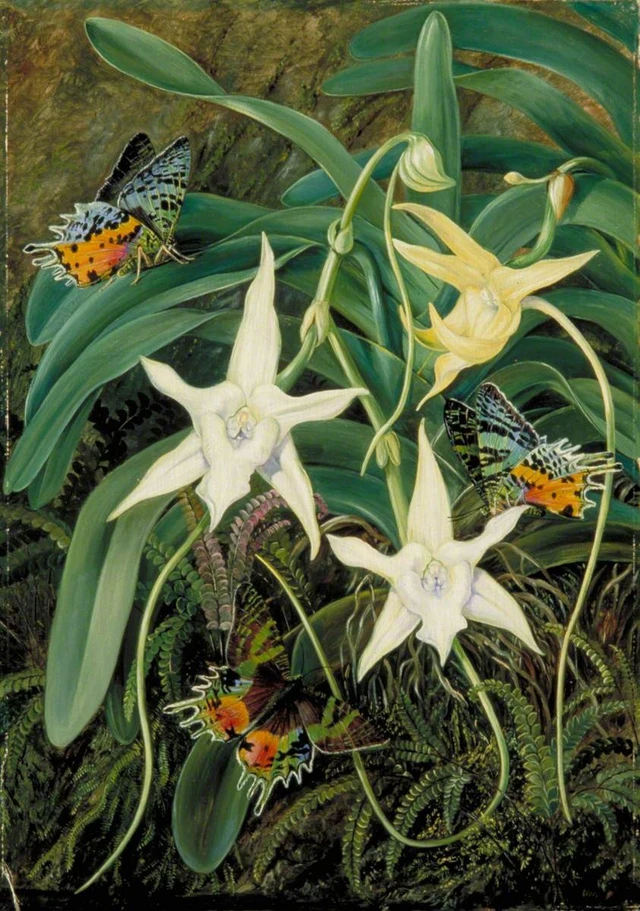
From a Flower to an Unseen Moth
Darwin follows the nectar at the bottom of a flower to the proboscis of a moth he has not seen: a passage from his orchid book.
I fear that the reader will be wearied, but I must say a few words on the Angræcum sesquipedale, of which the large six-rayed flowers, like stars formed of snow-white wax, have excited the admiration of travellers in Madagascar. A whip-like green nectary of astonishing length hangs down beneath the labellum.
In several flowers sent me by Mr. Bateman I found the nectaries eleven and a half inches long, with only the lower inch and a half filled with very sweet nectar.
What can be the use, it may be asked, of a nectary of such disproportional length? We shall, I think, see that the fertilisation of the plant depends on this length and on nectar being contained only within the lower and attenuated extremity. It is, however, surprising that any insect should be able to reach the nectar: our English sphinxes have probosces as long as their bodies: but in Madagascar there must be moths with probosces capable of extension to a length of between ten and eleven inches!