Do We See Light, or Dust?
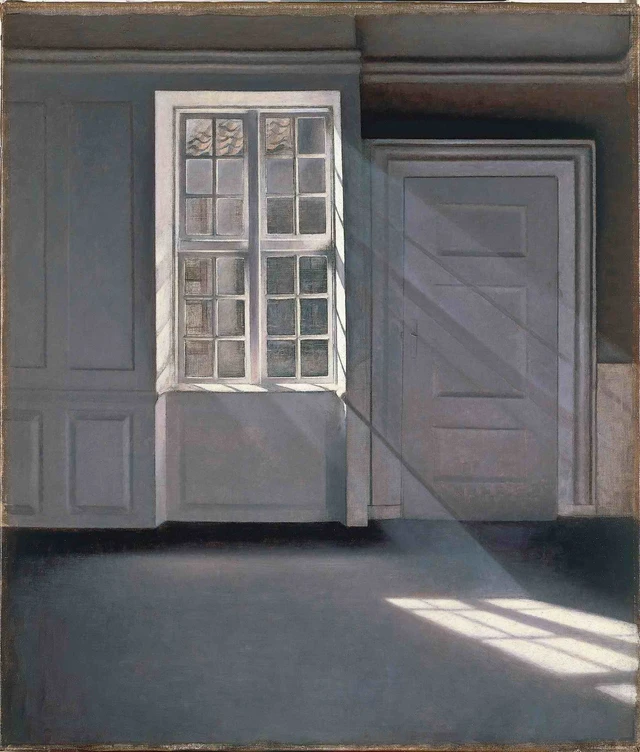
John Tyndall describes an experiment in which clearing the air makes a luminous beam’s path go dark.
In a cylindrical beam, which strongly illuminated the dust of the laboratory, I placed an ignited spirit-lamp. Mingling with the flame, and round its rim, were seen curious wreaths of darkness resembling an intensely black smoke. On placing the flame at some distance below the beam, the same dark masses stormed upwards. They were blacker than the blackest smoke ever seen issuing from the funnel of a steamer; and their resemblance to smoke was so perfect as to lead the most practised observer to conclude that the apparently pure flame of the alcohol lamp required but a beam of sufficient intensity to reveal its clouds of liberated carbon.
But is the blackness smoke? This question presented itself in a moment and was thus answered: A red-hot poker was placed underneath the beam: from it the black wreaths also ascended. A large hydrogen flame was next employed, and it produced those whirling masses of darkness, far more copiously than either the spirit-flame or poker. Smoke was therefore out of the question.
What, then, was the blackness? It was simply that of stellar space; that is to say, blackness resulting from the absence from the track of the beam of all matter competent to scatter its light. When the flame was placed below the beam the floating matter was destroyed in situ; and the air, freed from this matter, rose into the beam, jostled aside the illuminated particles, and substituted for their light the darkness due to its own perfect transparency.
Nothing could more forcibly illustrate the invisibility of the agent which renders all things visible. The beam crossed, unseen, the black chasm formed by the transparent air, while, at both sides of the gap, the thick-strewn particles shone out like a luminous solid under the powerful illumination.