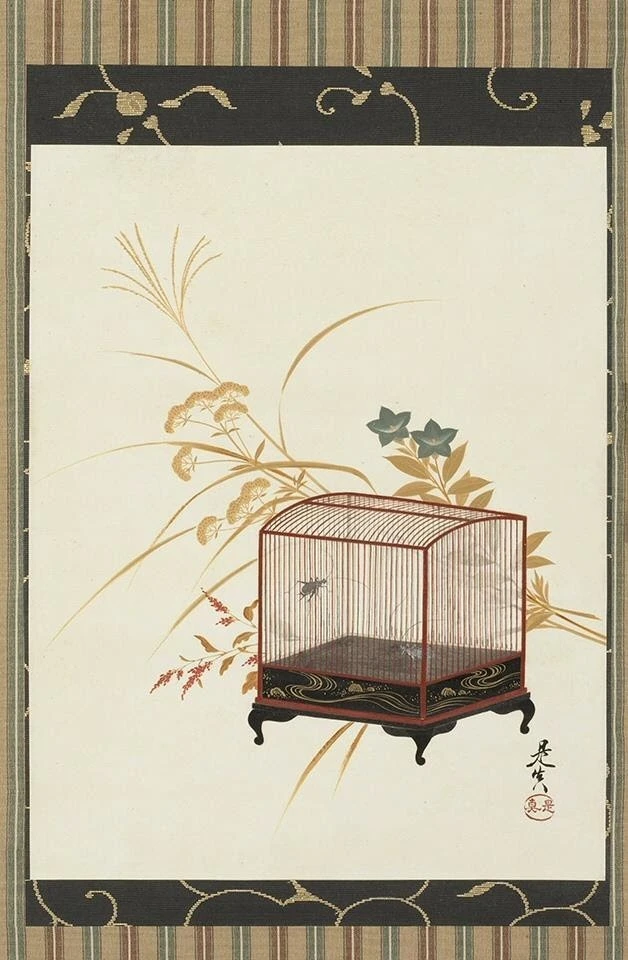
Cages for Listening
Lafcadio Hearn on an insect-seller’s stall, and an art of listening a passing traveller might mistake for a toy.
If you ever visit Japan, be sure to go to at least one temple-festival,—en-nichi. The festival ought to be seen at night, when everything shows to the best advantage in the glow of countless lamps and lanterns. Until you have had this experience, you cannot know what Japan is,—you cannot imagine the real charm of queerness and prettiness, the wonderful blending of grotesquery and beauty, to be found in the life of the common people.
In such a night you will probably let yourself drift awhile with the stream of sight-seers through dazzling lanes of booths full of toys indescribable—dainty puerilities, fragile astonishments, laughter-making oddities;—you will observe representations of demons, gods, and goblins;—you will be startled by mandō—immense lantern-transparencies, with monstrous faces painted upon them;—you will have glimpses of jugglers, acrobats, sword-dancers, fortune-tellers;—you will hear everywhere, above the tumult of voices, a ceaseless blowing of flutes and booming of drums.
All this may not be worth stopping for. But presently, I am almost sure, you will pause in your promenade to look at a booth illuminated like a magic-lantern, and stocked with tiny wooden cages out of which an incomparable shrilling proceeds. The booth is the booth of a vendor of singing-insects; and the storm of noise is made by the insects. The sight is curious; and a foreigner is nearly always attracted by it.
But having satisfied his momentary curiosity, the foreigner usually goes on his way with the idea that he has been inspecting nothing more remarkable than a particular variety of toys for children. He might easily be made to understand that the insect-trade of Tōkyō alone represents a yearly value of thousands of dollars; but he would certainly wonder if assured that the insects themselves are esteemed for the peculiar character of the sounds which they make.
It would not be easy to convince him that in the æsthetic life of a most refined and artistic people, these insects hold a place not less important or well-deserved than that occupied in Western civilization by our thrushes, linnets, nightingales and canaries. What stranger could suppose that a literature one thousand years old,—a literature full of curious and delicate beauty,—exists upon the subject of these short-lived insect-pets?
The object of the present paper is, by elucidating these facts, to show how superficially our travellers might unconsciously judge the most interesting details of Japanese life. But such misjudgments are as natural as they are inevitable. Even with the kindest of intentions it is impossible to estimate correctly at sight anything of the extraordinary in Japanese custom,—because the extraordinary nearly always relates to feelings, beliefs, or thoughts about which a stranger cannot know anything.