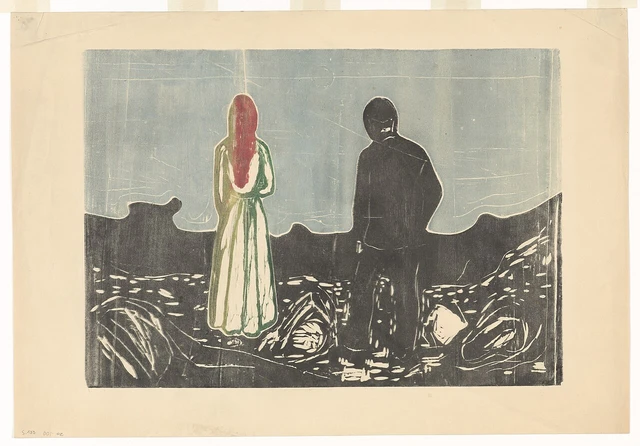
Alone, but Not Abandoned
A passage from the seventh of the Letters to a Young Poet, on solitude and learning to love.
And you must not let your solitude be unsettled by the fact that something within you wishes to escape it. This very wish, if you use it calmly and thoughtfully, as a tool, will help you extend your solitude over a wide country.
People, with the help of conventions, have resolved everything toward the easy and toward its easiest side. Yet it is clear that we must hold to what is difficult. Everything alive does so; everything in nature grows and defends itself in its own way, is something of its own from within itself, and tries at every cost and against every resistance to be so. We know little, but that we must hold to difficulty is a certainty that will not leave us. It is good to be alone, because solitude is difficult; that something is difficult must be one more reason for us to do it.
It is also good to love, because love is difficult. For one human being to love another is perhaps the hardest task laid upon us, the utmost, the final trial and test, the work for which all other work is only preparation. That is why young people, beginners in everything, do not yet know how to love: they must learn it. With their whole being, with all their powers gathered around their solitary, anxious, upward-beating heart, they must learn to love.
But a period of learning is always long and secluded. And so, for a long time and far into life, loving means solitude for the one who loves, an intensified and deepened being alone.
Loving is not, at first, dissolving into another, surrendering oneself and uniting with a second person. For what would a union of things still unclear and unfinished, still disordered, amount to? It is a lofty occasion for the individual to mature, to become something within himself, to become a world, to become a world for himself for another's sake. It is a great, immodest demand upon him, something that chooses him and calls him to wide distances.
Only in this sense, as a task of working on themselves, of “listening and hammering day and night”, should young people use the love given to them. Dissolving into another, surrender and every form of togetherness are not for them, who must still save and gather for a very, very long time. These are the final things, perhaps things for which human lifetimes are still scarcely sufficient.